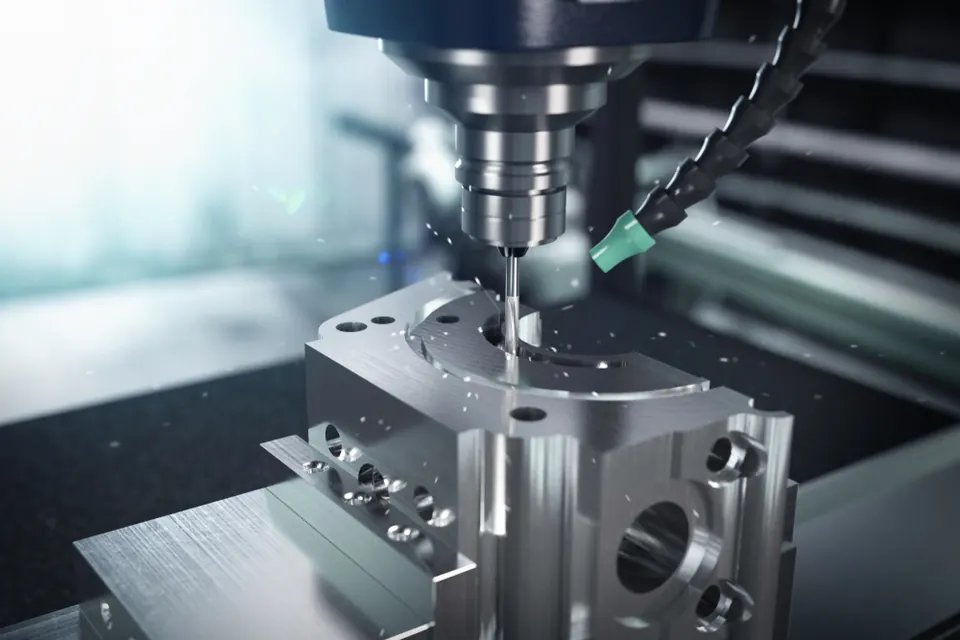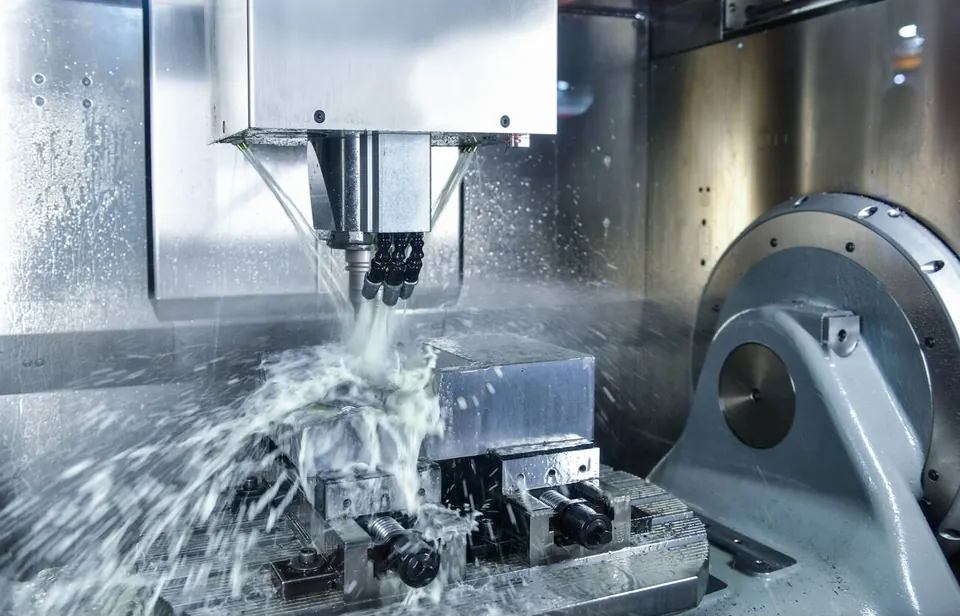
Axes and kinematics
A 5-axis machine combines the linear axes X, Y and Z with two rotary axes. On trunnion machines the table tilts (A or B) and rotates (C); on head-head machines the spindle head swivels; table-head designs combine both. Each kinematic has different working envelopes and stiffness.
Select an axis
X — longitudinal travel of the table (left–right).
Y — cross travel towards or away from the operator.
Z — vertical travel of the spindle; sets cutting depth.
A — rotation about X: the trunnion tilts the part so the tool reaches angled faces and undercuts.
C — rotation about Z: the rotary table indexes or turns the part continuously.
A trunnion-type 5-axis machine adds two rotary axes to the three linear axes. Select an axis to see how it moves.
Head-head and table-head kinematics use different axis pairs (e.g. B/C); the principle is the same.
3+2 versus simultaneous 5-axis
| 3+2 (positional) | Simultaneous 5-axis | |
|---|---|---|
| Motion | Rotary axes position, then lock; cutting in 3 axes | All axes may move during cutting |
| Typical use | Multi-face prismatic parts, angled holes | Impellers, blades, ports, freeform surfaces |
| Benefits | Stiff, accurate, short tools | Continuous tool orientation, smooth surfaces |
| Programming | Moderate | Advanced CAM, collision checking essential |
When multi-axis machining pays off
- Several faces machined in one clamping, so features relate to the same datum system.
- Shorter tools at tilted orientation reduce deflection and chatter.
- Undercuts and compound-angle features become possible without special fixtures.
- Freeform surfaces with better finish thanks to optimal tool contact.
When it does not
Five-axis machining is not automatically more accurate or economical. Rotary axes add their own geometric errors; simple plates and shafts are often cheaper on 3-axis machines or lathes. We choose the process per part, and sometimes split operations between machines to keep cost reasonable.
Workholding for 5-axis
Access is everything: dovetail fixtures, zero-point clamping systems and raised workholding leave the part free on five sides. A sacrificial clamping stub may be left on the blank and removed in a final operation — please tell us if any surface may not carry such a feature.