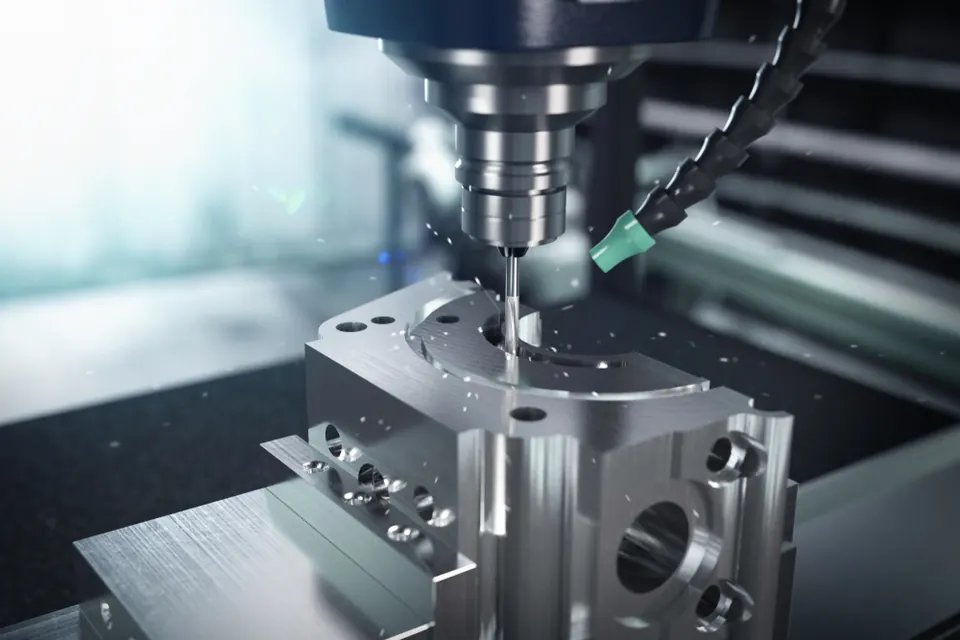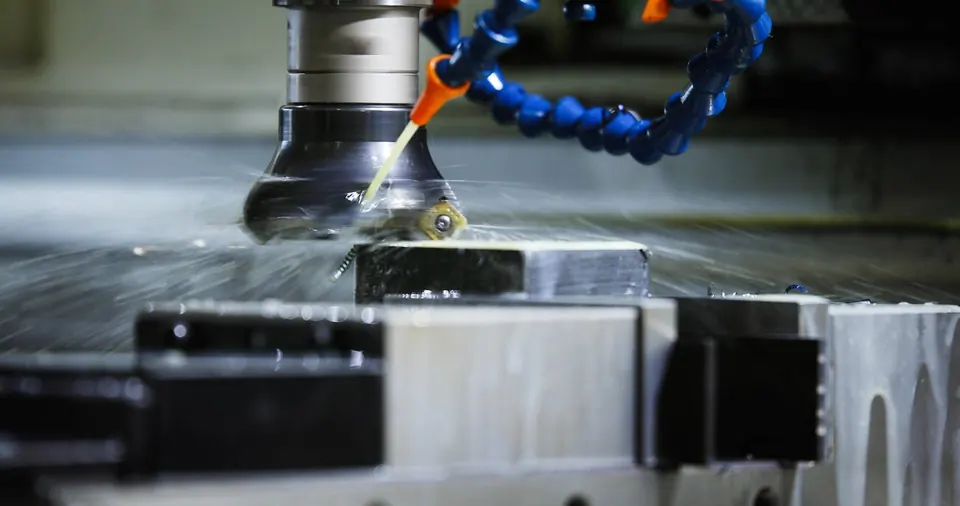
How milling works
In milling the tool rotates and the workpiece — or the spindle — moves along the X, Y and Z axes. Vertical machining centres (VMC) hold the spindle vertically and suit plates and housings; horizontal machining centres (HMC) with pallet changers and a rotary table suit multi-face parts and series production.
Cutting parameters
Four values define a milling cut: cutting speed vc, feed per tooth fz, axial depth ap and radial depth ae. From them follow spindle speed, feed rate and metal removal rate. Use the milling calculator for quick values.
| Parameter | Symbol | Unit | Effect |
|---|---|---|---|
| Cutting speed | vc | m/min | Tool life, heat, built-up edge |
| Feed per tooth | fz | mm | Chip thickness, finish, cutting forces |
| Axial depth of cut | ap | mm | Removal rate, deflection |
| Radial depth of cut | ae | mm | Engagement angle, heat, chip thinning |
Strategies
- Adaptive / trochoidal roughing keeps engagement constant and allows full flute length at low ae — lower heat, longer tool life and safer cutting in steels and titanium.
- Rest machining removes material left by larger tools in corners.
- Finishing with constant scallop height or contour-parallel paths for walls and 3D surfaces.
- Climb milling is generally preferred on CNC machines for better finish and tool life.
Typical capabilities and limits
Achievable accuracy depends on part size, material, set-up and environment. As orientation, general features are machined to ISO 2768-m; precision features such as bearing bores and dowel holes to IT7 or better when specified and measurable. Thin walls, long tool overhangs and deep narrow pockets limit what is economical — see design for machining.
Specific machine models, travels and capacities for your part are confirmed in the quotation. We do not publish an equipment list that could be outdated or misleading.
Design tips for milled parts
- Internal corner radius at least slightly larger than the cutter radius (e.g. R3.2 for a ⌀6 cutter).
- Pocket depth up to about 3–4 × cutter diameter for standard tools.
- Wall thickness ≥ 1 mm in aluminium and ≥ 1.5 mm in steel as a starting point for moderate heights.
- Standard hole sizes and thread sizes; avoid deep small threads.
- Group features to be machined from the same side.