What is CNC machining?
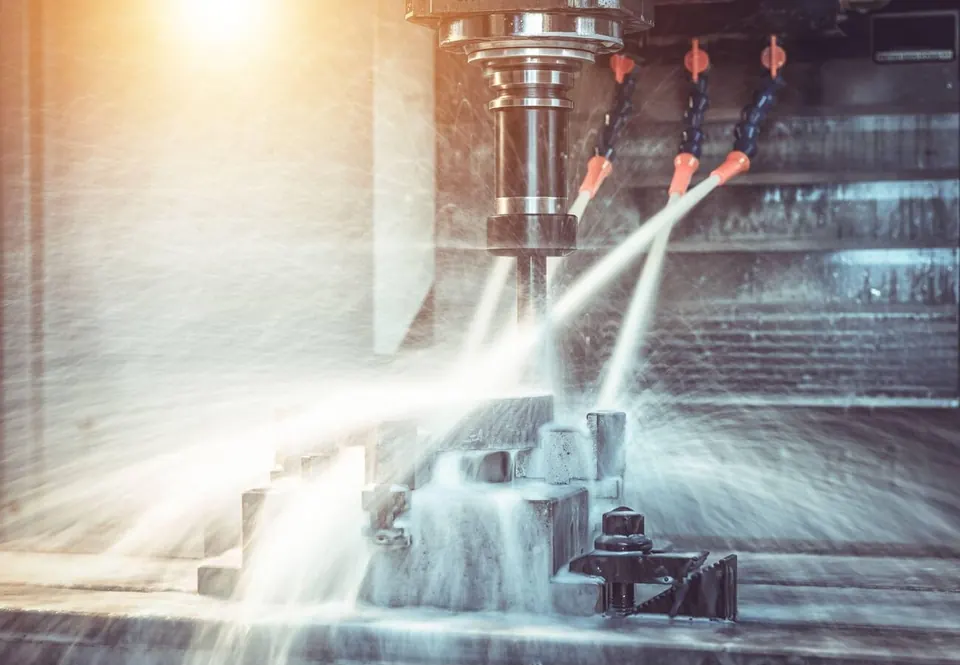
CNC machining is a subtractive manufacturing process: a machine tool removes material from a solid blank — bar, plate, forging or casting — with rotating or stationary cutting tools whose movements are controlled by a program. The program is generated by CAM software from the 3D model and contains tool paths, spindle speeds, feeds and tool changes.
Compared with forming or casting, machining achieves the tightest tolerances and best surfaces on functional features, with no tooling investment. It is therefore used both on its own and as the finishing step for castings, forgings and weldments.
A short history
Numerical control began in the late 1940s and 1950s, when punched-tape controls were developed for aircraft parts in the United States. Computer numerical control followed with microprocessors in the 1970s. Since then, CAM software, high-speed spindles, multi-axis kinematics, in-machine probing and automation have turned CNC machining into the backbone of precision manufacturing worldwide.
The main processes
CNC Milling
Prismatic parts, pockets, contours and 3D surfaces on 3-, 4- and 5-axis machining centres.
Read moreCNC Turning
Shafts, bushings, flanges and fittings — rotational parts turned from bar, forgings or castings.
Read more5-Axis Machining
3+2 positioning and simultaneous five-axis milling for complex geometry in fewer set-ups.
Read moreMill-Turn
Turning plus milling, drilling and tapping with C- and Y-axis — complete parts in one clamping.
Read moreSwiss-Type Turning
Sliding-headstock lathes for small, long and slender precision parts from bar.
Read morePrototype to Production
First articles, pilot batches and stable series — the same engineering logic at every stage.
Read more| Process | Typical parts | Strengths | Watch-outs |
|---|---|---|---|
| CNC milling (3-axis) | Plates, housings, brackets | Flexible, economical for prismatic parts | Several set-ups for multi-face parts |
| 3+2 / 5-axis milling | Complex housings, impellers, aerospace parts | Fewer set-ups, access to angled features | Higher hourly rate, programming effort |
| CNC turning | Shafts, bushings, flanges | Fast and accurate for rotational parts | Off-axis features need extra operations |
| Mill-turn | Shafts with flats, holes, keyways | Complete machining in one set-up | Higher machine cost |
| Swiss-type turning | Small slender parts, pins, connectors | Long thin parts at high precision | Bar diameter range limited by machine |
How a part is made
- Review. Drawing and model are checked for manufacturability, tolerances, materials and inspection needs.
- Process planning. Machines, set-ups, workholding and tools are defined; critical features are machined in the same set-up as their datums where possible.
- Programming. CAM tool paths are created and simulated to detect collisions and gouges.
- Material. Certified stock is ordered or allocated, with heat numbers recorded.
- Machining. First part is measured before the batch continues.
- Secondary processes. Heat treatment, coatings or finishing are carried out — in-house in the organisation or through qualified partners.
- Inspection. Dimensions, surfaces and documents are verified against the agreed plan.
- Packing and shipping. Parts are cleaned, protected and packed for export.
What drives cost
- Set-ups and complexity. Each re-clamp adds time and potential error. Designing for fewer set-ups lowers cost.
- Tolerances. Moving from general tolerances to IT6 or tight geometrical tolerances adds slower finishing, measurement and sometimes grinding.
- Material. Price per kg and machinability both matter: a titanium part may cost several times its aluminium equivalent in cutting time.
- Quantity. Programming and set-up are spread over the batch; fixtures pay off at volume.
- Documentation. First article reports, CMM programs and certificates require effort that should be specified up front.
Türkiye has a broad machining supply base, short transport routes to Europe and a customs union with the EU for industrial goods. For North American buyers, sea and air connections from Turkish ports and hubs are well established. MACHINING.TR combines this base with engineering review and documentation in English, German, French and Dutch on the website.