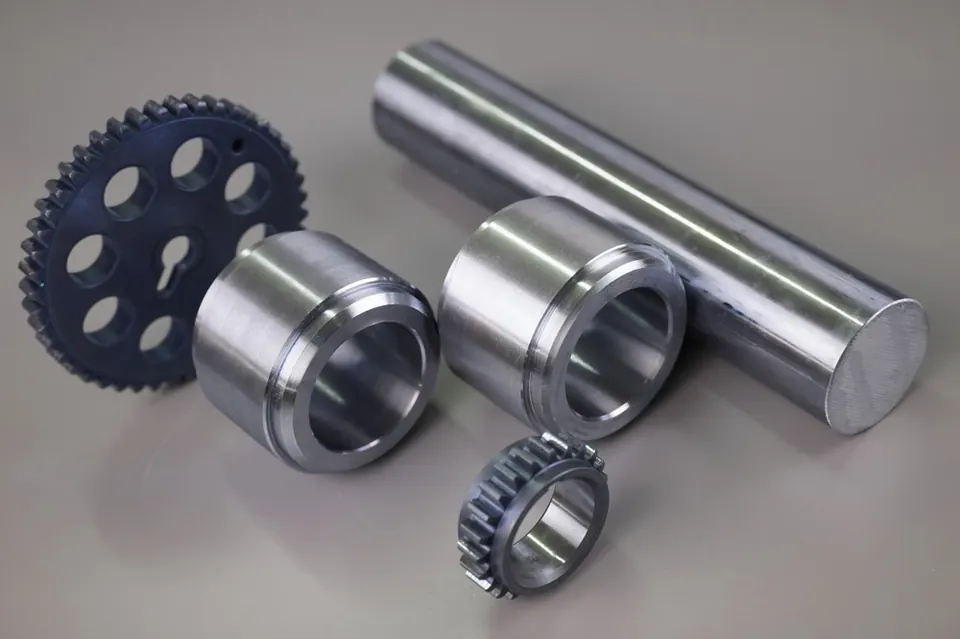
Machined automotive parts range from high-volume turned pins and fittings to milled housings and brackets for powertrain, chassis and e-mobility. Buyers expect stable processes, capability evidence on special characteristics and packaging suited to their assembly lines.
Typical machined components
- Shafts, pins and spacers
- Hydraulic and brake fittings
- Sensor and connector housings
- Turbocharger and pump components
- Brackets and mounting plates
- E-motor and battery system parts
Common materials
Materials · Material Equivalents
Manufacturing processes
Machining challenges
- Cycle time and cost per part at volume
- Holding capability (Cpk) on special characteristics over long runs
- Burr-free cross-holes in fluid-carrying parts
- Lead and other substance restrictions in free-cutting materials
Dimensional requirements
Functional diameters commonly sit in IT6–IT8; other features follow ISO 2768-m or customer general tolerances. Special characteristics are marked on drawings and need capability data.
Surface finish requirements
Ra 0.8–3.2 µm for most functional surfaces; sealing surfaces may specify Rz or lay direction. Technical cleanliness limits may apply to fluid-system parts.
Inspection requirements
Control plans, SPC on special characteristics, gauge-based in-process checks and initial sample reports. PPAP or VDA 2 submission levels as agreed per project.
Relevant standards
| IATF 16949 | Automotive quality management system requirements, built on ISO 9001. |
| AIAG PPAP / VDA 2 | Production part approval process (AIAG) and the German VDA volume 2 equivalent (PPA). |
| ISO 2859-1 | Sampling procedures for inspection by attributes, indexed by acceptance quality limit (AQL). |
| ISO 2768-1 / -2 | General tolerances for linear and angular dimensions (part 1: f, m, c, v) and for geometrical features without individual indications (part 2: H, K, L). Part 2 is being superseded by ISO 22081. |
| EN 10204 | Types of inspection documents for metallic products: 2.1, 2.2, 3.1 and 3.2. The 3.1 certificate is the usual minimum for traceable machined parts. |
Engineering considerations
- Choose free-cutting grades where function allows
- Specify thread tolerance classes and edge conditions
- Define cleanliness and packaging requirements early
- Mark special characteristics clearly
Potential manufacturing solutions
Bar-fed CNC and Swiss-type turning for volume parts, multi-pallet milling for housings, and documented process control. Heat treatment and plating are coordinated through partner suppliers with traceable lots.
Requirements depend on the specific part, drawing and customer specification. Sector approvals or certifications are not implied; where a project requires them, this is confirmed during the RFQ review.