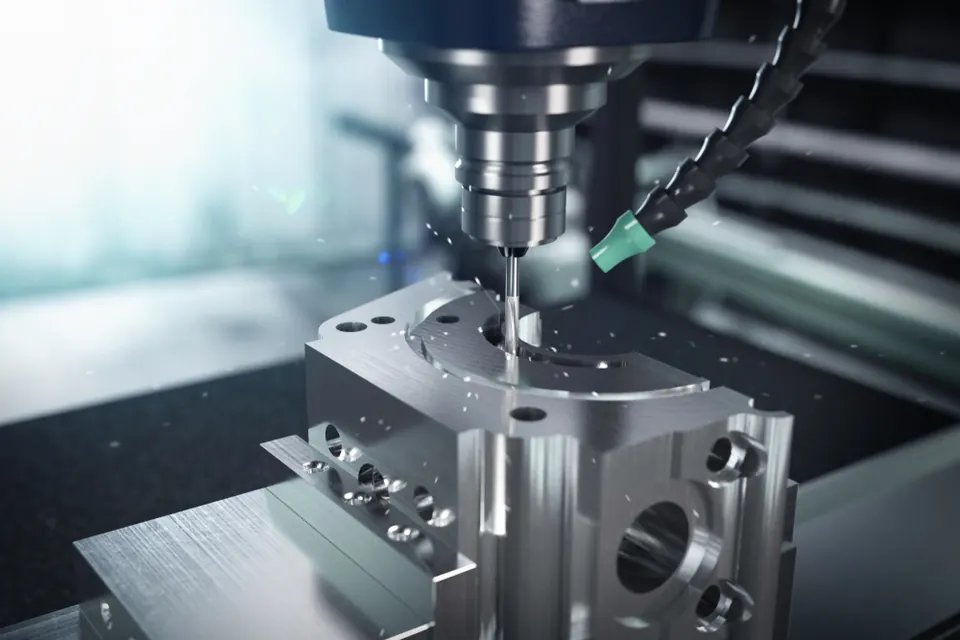
Operations
| Operation | Typical tolerance | Typical Ra | Notes |
|---|---|---|---|
| Twist drilling (carbide) | IT9–IT11 | 1.6–6.3 µm | Fast; position depends on machine and entry |
| Reaming | IT6–IT8 | 0.4–1.6 µm | Follows hole axis, does not correct position |
| Fine boring | IT6–IT7 | 0.4–1.6 µm | Corrects position and straightness |
| Interpolated milling | IT8–IT9 | 1.6–3.2 µm | One tool for many sizes |
Deep holes
Holes deeper than about 10 × diameter need special strategies: pilot holes, through-coolant drills, peck cycles or gun drilling. Straightness and run-out of the hole become critical; we review depth-to-diameter ratio at the quotation stage.
Design rules
- Use standard drill sizes and add tolerance only where needed (e.g. dowel holes H7).
- Flat-bottom holes require end mills or special drills — a 118°/140° drill point is cheaper.
- Avoid holes starting on inclined or curved surfaces; add a spot face.
- Cross-holes create burrs at intersections — specify edge condition.
- Give position tolerances relative to functional datums.