Processes
| Process | Typical use | Tolerance (indicative) | Ra (indicative) |
|---|---|---|---|
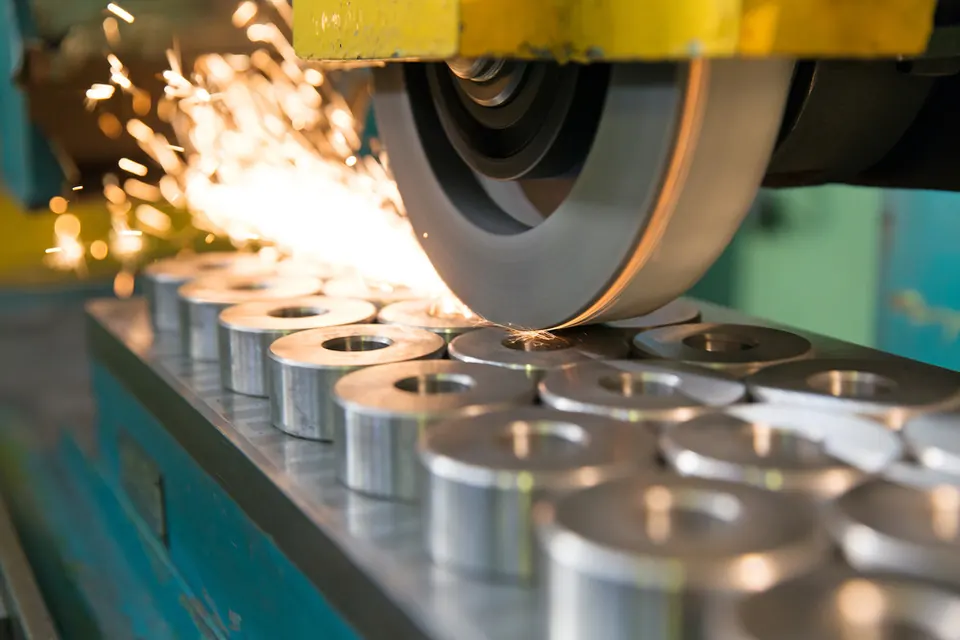
| Cylindrical grinding | Shafts, journals, pins | IT5–IT6 | 0.2–0.8 µm |
| Surface grinding | Flat faces, plates, blocks | Flatness of a few µm over small areas | 0.2–0.8 µm |
| Internal grinding / honing | Bores, cylinders | IT5–IT6 | 0.1–0.4 µm |
| Lapping | Sealing faces, gauge surfaces | Flatness in light bands | 0.05–0.2 µm |
| Polishing / electropolishing | Hygienic, cosmetic surfaces | — | down to < 0.2 µm |
Hard turning and hard milling
Hardened steels above ~ 45 HRC can often be turned or milled with CBN or ceramic tools instead of grinding — faster and more flexible for complex profiles, but grinding remains superior for the tightest tolerances and certain surface-integrity requirements.
Deburring and edge finishing
Edges are part of the specification. Programmed chamfers, brushing, tumbling, thermal or electrochemical deburring are chosen according to geometry and material. Drawings should define edge conditions per ISO 13715.